
6-8 minute read
Every organization has them. Metrics and incentives that once made sense — or at least seemed to — and then never got revisited. They sit quietly in the compensation structure, the scorecard, or the performance review, rewarding behaviors that work against the results the organization says it wants.
Most of the time, nobody notices. Performance feels normal. The gap between what the system rewards and what the business actually needs is just... “the way things are”.
Then someone decides to make a real change. A new process. A new approach to how work flows, how customers are served, how decisions get made. And for a while, it works. Results improve. People engage. The future looks different.
Then the drift starts. Slowly, behavior slides back. The improvement erodes.
So, what happened?
What happened is that the change ran headlong into something that was already there. Something from the old way that didn’t die, even though it should have.
A zombie measurement.
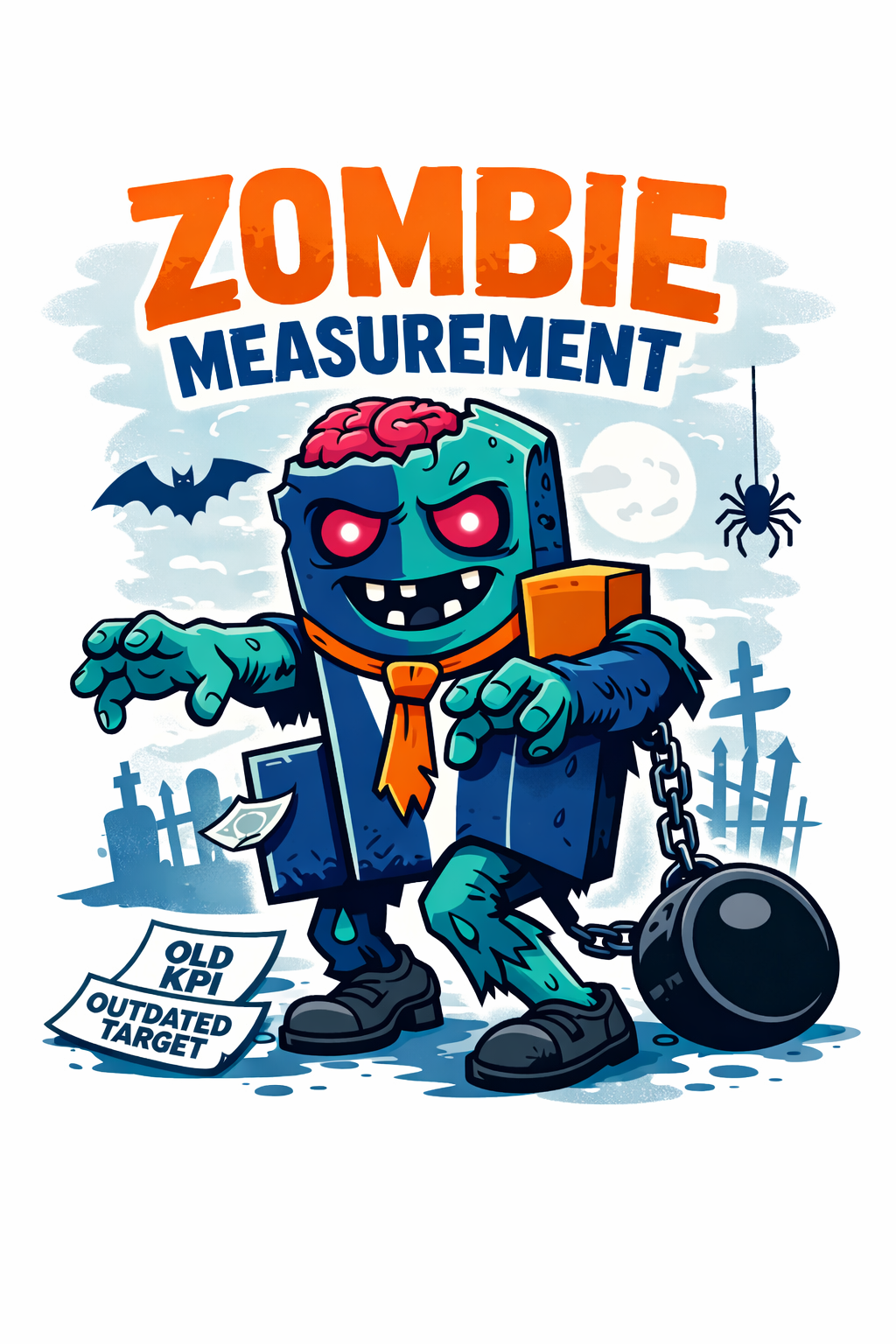
What is a Zombie Measurement?
A zombie measurement is a metric or incentive that should have died long ago, but didn't. The metric may have made sense once or it may never have made sense at all. Either way, it didn't die when it should have. It wanders around destroying the results the organization actually wants, protected by an assumption so familiar nobody thinks to question it. And because of this familiar assumption, no one connects the measurement to the damage it’s doing.
Most of you know me by now, so you won’t be surprised to hear me say that zombie measurements are perfect candidates for assumption hacking.
This is the first in a series of newsletters on them, and sales incentives provide a perfect place to start.
Zombie 1: Sales Commissions
Sales commissions are one of the most familiar compensation systems in business.
The logic seems straightforward: the more revenue someone generates, the more they earn and the more the company earns. The assumption is that tying pay directly to each sale will keep salespeople focused on chasing and closing more deals every minute of the day. If they were paid any other way, the thinking goes, their motivation to do so would disappear.
By the way, although I'm using sales commissions as the example in this newsletter, if you’re still paying anyone in your company per unit of output, you’ve got the same zombie, it’s just wandering around in different departments. You’re a garment company still paying your sewing workers by the piece? Same zombie. You’re an automative service company still paying your techs flat rate? Same zombie.
The Damage the Zombie Does
Individual Behavior
When compensation is tied directly to individual deals, salespeople naturally gravitate toward the opportunities that would maximize their personal income. When this happens, some deals get more attention than they otherwise would and other deals get less attention, leaving potential customers feeling unappreciated. A salesperson paid on commission has every reason to close the deal in front of them, but no particular reason to ask whether the business can actually deliver it profitably. A sale that overwhelms a constraint or quietly erodes profit still pays the same commission. The system rewards the close, but what happens after the close is someone else's problem.
Sometimes, the pressure shifts toward persuading a customer to buy something they didn’t originally intend to buy. Anyone who has ever purchased a car is familiar with the reputation that follows sales incentives like these. Most customers walk into a dealership already bracing themselves for upselling, high pressure, and creative persuasion. That reputation didn’t appear out of thin air. It’s a predictable byproduct of a zombie incentive system designed to reward closing every deal for as much money as they can possibly squeeze from the customer.
But this dynamic doesn’t stop at the individual salesperson. The zombie attacks sales department policies and management behavior too.
Policy & Management Behavior
Sales organizations naturally try to protect their strongest performers and because of this, when new leads arrive, the best salespeople often get the first shot at them — the pick of the litter. At first glance, that seems logical. If anyone can convert a lead into a sale, it's one of the top producers. And if anyone will kill a sale, it will be those at the bottom. So then why should the company waste good leads on its bottom producers? No, the thinking goes, those bottom producers need to earn their way to the good leads.
Let’s look at this from a flow perspective. Little’s Law tells us that the more items there are in a system, the more waiting time increases and the longer it will take for those items to go through the system. In this case, it means the more leads a salesperson receives, the more time customers spend waiting for salespeople (a nice way to say that some leads get ignored). Leads that may very well have been ripe for conversion quietly fall through the cracks.
Sales here are lost not because the opportunities were bad, but because of the way the workload was distributed. Yet the conversion rate of the top producers is held as a holy grail, even though more sales likely could have been generated by them and others.
OK, we’ve talked about individual-level sales practices and the typical approach to distributing new leads. Let's see how the zombie commission systems affect teamwork.
Team Behavior
In a word, they make teamwork difficult. For example, if two salespeople contribute to a deal, the question quickly becomes: Who gets how much of the commission?
The simplest answer is to work alone. So instead of creating coordinated teams focused on helping customers make good decisions, many sales departments quietly become collections of lone rangers competing for opportunities.
Let's take another look at the ramifications of how leads are distributed. Don't worry, I'm not advocating that companies hold on to anyone that proves they are unfit to do the job they are there to do. But companies do hang on to salespeople who are unfit when they have commission based pay in place, believing that there is no damage because those salespeople don't get paid until and unless they sell something. Can you imagine what the effects are on teamwork and morale when poor performers stick around? The impact on management attention?
Some organizations move away from commission based on revenue or margin and compensate salespeople based on volume instead — more units moved, more pay earned. There may be a base pay threshold, but the principle is the same: more volume, more compensation. It's still a commission, and the underlying assumption hasn’t changed.
Individual output is measured and rewarded as if the salesperson is an independent unit, disconnected from the system around them. A salesperson chasing volume faces the same pressures as one chasing revenue or margin-based commission — to push products that are easier to sell, to load up their workload beyond what the operation can absorb, and to work alone rather than collaborate. The zombie looks different, but it behaves the same way.
None of this happens because people are bad actors.
It happens because the compensation system rewards these behaviors.
Zombies Are Hard To Kill
In zombie mythology, half-measures don't work. A wounded zombie is still a zombie. The only way to stop one is to destroy the brain — decisively, completely, no half-measures.
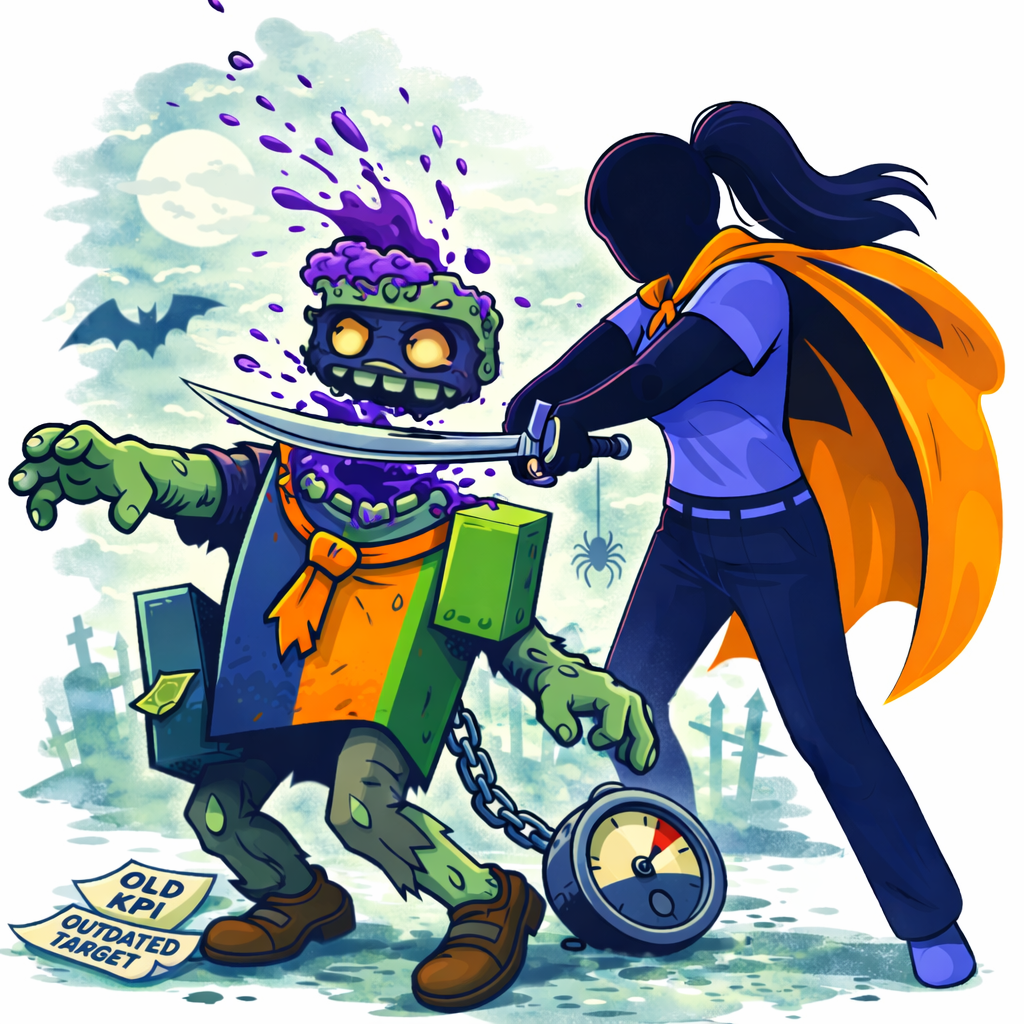
Assumptions work the same way. Knowing a zombie measurement exists doesn't make it easy to eliminate. There's usually a deeply held belief or two protecting it. You can't partially question these beliefs. You can't acknowledge that a measurement might be causing problems while leaving the incentive intact because "that's just how it is." A zombie survives on exactly that kind of hesitation.
In sales, the assumption is something like this: salespeople are only motivated by money. The assumption feels so obvious, so self-evident, that questioning it seems almost naive. (There's another that we'll look at in a forthcoming issue: that salespeople who are paid via commission are a variable cost. But we'll leave that one alone for today.)
But that's exactly what makes it a zombie. The belief doesn't just survive — it defends itself. Give them a SPIFF, watch them perform. Take away their commission, watch sales go down. And I've heard this line more than once: "Lisa, just look at all the other companies in our industry, and you’ll see, that’s just the way it is."
This is where assumption hacking gets uncomfortable. Examining an assumption isn't the same as challenging it with the conviction that you're right. That's just arguing. Real assumption hacking requires something harder. It demands that you approach the belief with genuine openness to being wrong. Not performing skepticism. Actually being willing to discover that the thing you've built your system around isn't true.
The brain of this particular zombie is the belief that people need to be financially incentivized to perform — that without it, the motivation disappears. That belief is worth examining not with the confidence that it's wrong, but with the genuine curiosity to find out.
Have you witnessed any organizations where salespeople don’t earn commissions, yet they’re top performing salespeople? What is different? If your answer is only that business isn’t your industry, or that the proof is in what happened when you adjusted their compensation plans in the past, I challenge you to look deeper.
Why This Matters
Now imagine an organization that decides to implement TOC — or any serious improvement effort that requires people to see the business as a whole interconnected system, not a collection of independent performers. Leaders want to build trust, collaboration, and long-term relationships with customers. They want decisions made with the whole system in mind, not just the next deal.
But the commission structure remains unchanged. It’s a zombie, a relic of some decision that was made long ago and no one knows what to do with it.
Even if leaders communicate a new direction, the zombie incentive system eventually pulls behavior back toward the old world.
I’ve been writing about what it takes to sustain a change that has been implemented. Three things have to hold:
-
the new behaviors must become habits
-
leadership has to stay consistent
-
people need to keep seeing results that connect the change to real outcomes.
A zombie measurement quietly attacks all three at once — and here’s exactly how it plays out with sales commissions:
-
The new habits never form — because when a salesperson faces a choice between what the compensation system rewards and what the new approach asks for, the compensation system almost always wins.
-
The leaders who championed the change start sending mixed signals, because the scorecards still say something different.
-
And the visible results that proved the new approach was working start to erode. Eventually, it looks like the initiative just “didn’t stick.”
It didn’t fail because people weren’t trying. It failed because the measurement system was still fighting for the old world.
Most people arrive with intrinsic motivation already intact. They want to help customers, do quality work, and be part of something that functions well. Culture is what unlocks that. It’s what makes the intrinsic motivation available to the organization.
We’ve been sold a story that the compensation system does this work. It doesn’t. It never did.
Zombie Hunting In Your Business
If behavior keeps drifting back even though the new approach clearly works better, there is likely a zombie measurement wandering around.
Zombie measurements can’t be left to die on their own, because zombies don’t die on their own. They must be killed — deliberately, decisively, and before they feast on the behaviors you worked so hard to build.
This is the first in a series of newsletters on the subject of Zombie Measurements. In future issues, we will hack the assumptions that drive us to use cost accounting as our decision making backbone, individual and team efficiency as our operational performance lens, and budget versus actual as a management accountability driver.
Zombie Defense Starter-Pack
- Justin Roff-Marsh is a highly successful and well-regarded TOC expert with a focus on sales. Justin has been fighting the good fight against sales commissions for some time, and I encourage you to connect with him on LinkedIn and read his posts, articles and books.
- Dan Pink writes and speaks about motivation. His book, Drive: The Surprising Truth About What Motivates Us explains the 3 core drivers of motivation. And none of them include pay for output for anyone with a job that requires anything more than purely rote mechanical skill. This short video that he produced with RSA Animate covers the subject in a captivating way.
Till next time,
Lisa
|
|||



Responses