
9 minute read
A few weeks ago I did a webinar for the TOC (Theory of Constraints) community on what makes implementations actually stick. Jelena Fedurko-Cohen, one of the webinar’s hosts, asked me a question I hadn't prepped for: What about Burning Man?
My husband and I went to Burning Man for the first time in 2011, and we've been there nearly every year since. Along the way, I've volunteered in enough corners of the local and global organization that I don't think of myself as someone studying this culture from the outside. I live inside it.
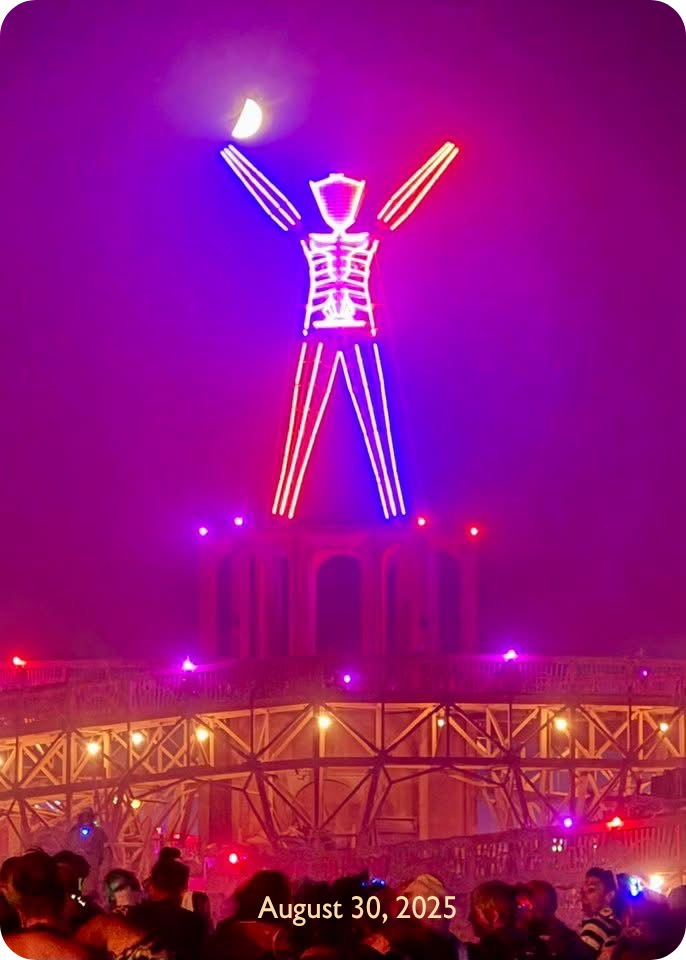
I thought I had this world of art and music and theme camps and mutant vehicles figured out. But as I’ve pondered Jelena's question, I realized Burning Man actually fits like a glove into the framework for sustainment I’ve been working on — and it forced me to go deeper into what I thought I already understood about Leadership Consistency.
Start with this: the first Burning Man happened 40 years ago this year. Larry Harvey, the man who started it all, died eight years ago. Not only did Burning Man not collapse without him — the global network is stronger now than it's ever been. More people go to regional Burning Man events around the world each year than go to the flagship event in the Black Rock Desert!
Background
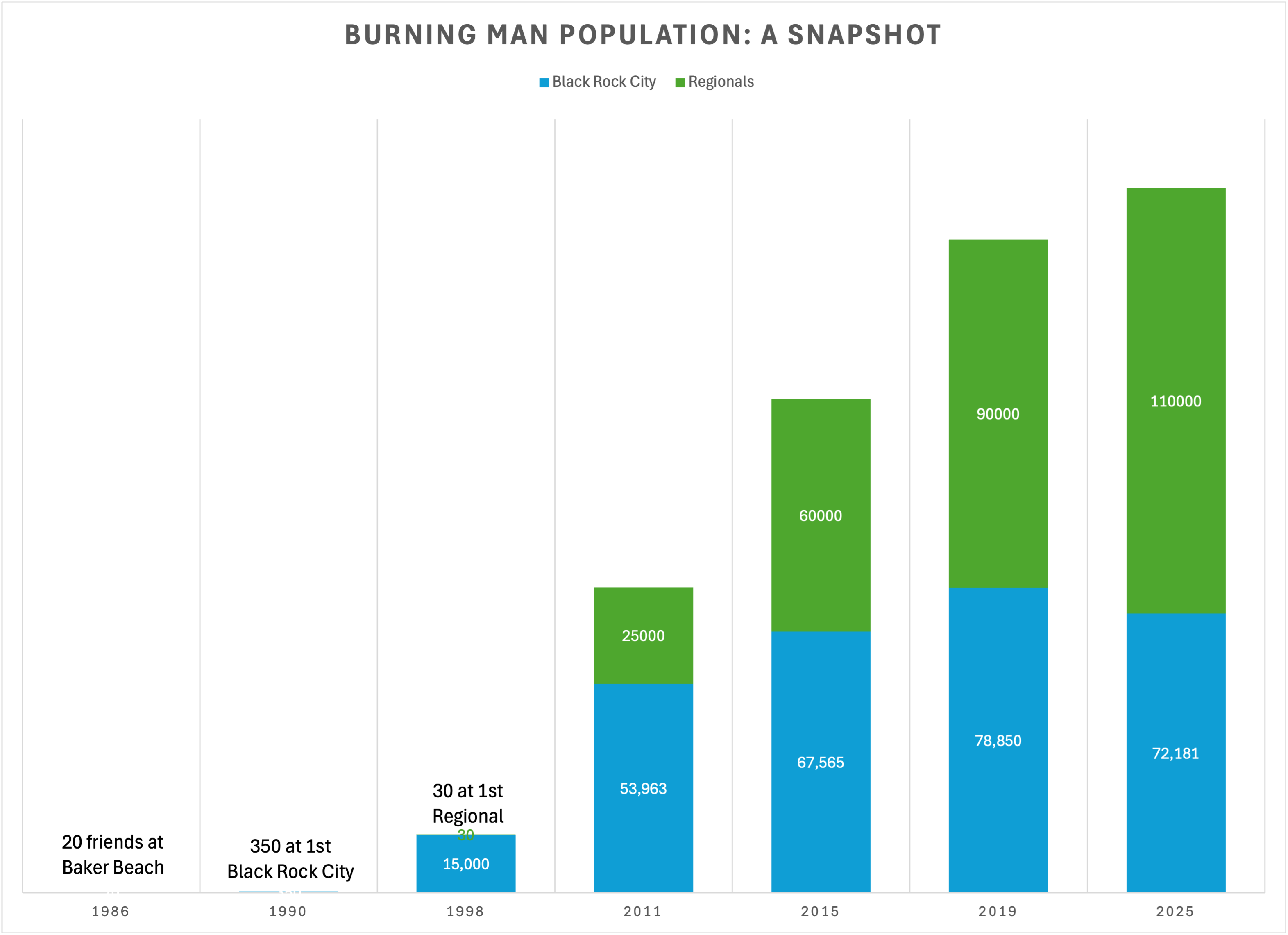
Burning Man started in 1986 as a small bonfire gathering of friends on Baker Beach in San Francisco. In 1990, it moved to the Black Rock Desert with 350 people. From there, growth was explosive — by 2013, nearly 70,000 participants. By 2019, almost 80,000.
Then something interesting happened: the population of Black Rock City stopped growing. In the post-Covid years of 2023-2025, the population has hovered between 70-75,000. If you only looked at the flagship event, you'd conclude Burning Man had plateaued, maybe even peaked.
But the flagship event isn't the whole story. While Black Rock City may have leveled off, its regional network kept climbing. Today there are 106 regional locations across 36 U.S. states and 34 countries, running more than 80 regional events a year — all volunteer-produced, not run by Burning Man Project itself.
The total number of participants in Black Rock City plus Regional Events in 2025 was about 182,000!
The Change: Implement The Regional Network
By 1997, people were making it clear that they wanted to bring their personal experience of Burning Man back to where they lived. So, the Regional Network was created, which consisted of the first Regional Contacts and the first “regional burn”, Burning Flipside (Texas, 1998).
As the network grew, it became apparent that something was needed to help the Regions preserve the culture of the flagship event within the events and activities now taking place under the name of Burning Man. In 2004, Burning Man formalized the network and created a department dedicated to helping its network (which consists of all volunteers) sustain and grow. This is also when Larry Harvey wrote The Ten Principles of Burning Man, which describe the culture that is alive and cherished at Black Rock City and anywhere you find Regional Events and other activities.
Although that great big party in the Black Rock Desert is still the biggest single event Burning Man Project throws each year, the Regional Network showed that this main event wasn't actually the goal. Burning Man Project describes its own mission as working "to facilitate and extend the culture that has emerged from the Burning Man event into the larger world."
Given the success and continued growth of the regional events, I think it's worthwhile for any of us who are interested in what sustains change within an organization to dive deeper into this. So here we go!
Applying The TOC Change Sustainment Framework to Burning Man
If you’ve read my newsletters over the course of the past year, you are familiar with the three critical success factors for sustaining changes that are made during a TOC Implementation. After the aforementioned webinar (where Jelena first got me thinking about this question), I more deeply examined Burning Man from the lens of the core change the organization had made by creating the Regional Network. And I found that when I apply the Critical Success Factors to Burning Man, I am able to replace “TOC” with the 10 Principles, as they are the verbalization of the culture that Burning Man’s mission says it is here to facilitate.
- Embedded Habits: Habits and practices that operationalize
TOCthe 10 Principles must be embedded in the organization’s way of working. - Ongoing, Visible Results:
TOCThe 10 Principles’ contribution to individual, team, and company ongoing growth & performance improvement must remain visible and undeniable. - Leadership Consistency: Leaders and managers must consistently lead, decide, and solve problems using
TOCthe 10 Principles — and they need to own these practices as their way of managing.
This wasn't a TOC implementation — Burning Man had never heard of the five focusing steps. But watch: the same three factors that make a TOC implementation sustain seem to be exactly what held this together.
The First Two Factors
The first two factors checked out quickly, and so we won’t spend too much time on them.
Embedded Habits are everywhere once you look. Event departments such as Greeters, Gate and Rangers all run on trained, repeatable habit loops of trigger → action → reward, identical whether you're at Black Rock City or a regional burn. Simple, built-in, and you know what? It works — skip it, and people notice. As someone who’s held the Greeter role at both Black Rock City and Arizona’s Saguaro Man, I can attest to that dopamine rush when the people you’ve just greeted move on with great big smiles on their faces as they anticipate their Burning Man experience!
Visible Results are just as institutionalized. Every regional event produces an AfterBurn Report — attendance, volunteer hours, art grants, finances, what went well and what needs improvement — and those reports roll up through annual recaps into a spring forum where the previous year's results drive the next year's changes. The feedback loop isn't an aspiration; it's the calendar. Stories are told throughout the year via Burning Man’s and Regionals’ publications and social media that personalize what volunteers are doing to the successes of their regional events and activities.
Two factors, clearly in place, doing exactly what the framework says they do. It was the third factor that was most illuminating for me.
Leadership Consistency
I’ve been “a burner” since 2011, I’ve been a Regional Contact and on our local board since 2020, and I’ve witnessed Burning Man’s intentionality in recruiting, onboarding, and sustaining the kind of leaders that embrace the culture at both the local and global levels. From when I met the guys who were the Regional Contacts for Arizona back in 2011, all the way through to the leaders of the various teams that put on Saguaro Man. Nearly every leader I’ve engaged with at Burning Man Project models the 10 principles.
And there’s something else. The best of them continue to reflect and learn these principles more deeply. No matter if they’ve been burning since the beginning or they’ve just started their leadership journey locally, they embrace and learn from those principles every day.
This is also something I see in great leaders of companies that choose to use TOC as their guide for managing well beyond the initial implementation. No matter how much they’ve “mastered” TOC, they actively continue to deepen their understanding of TOC every day, and hone what they learn into improvements in their implemenations. I'd call it further strengthening the platform they've built.
The Part I Almost Missed
As I reflected on Leadership Consistency, I did a thought experiment. I imagined what would happen if Burning Man Project's leadership decided to let corporations become sponsors — advertise, sell merchandise at the event, allow camps to have corporate branding ... It could certainly be a way to bring in funds and reduce the price of tickets or costs of attending. But if this were to happen, I can safely predict there would be a mass exodus of participants and volunteers, and perhaps even employees. Because leadership would have violated a principle - in this example Decommodification - and would have turned its event into just another festival. At a minimum, people would become distrustful, watching to see if what the organization says it is still means anything.
It explains what I see play out in various Burning Man social media forums. When people perceive that leadership - Burning Man Project leadership or leaders in their own region - is violating one or more principle, they'll get angry and call them out. IN ALL CAPS.
That thought experiment is what convinced me to take another look at those companies sustaining TOC. Leadership consistency isn't just about showing up the same way, day after day. It's about staying anchored to who and what you actually are — your mission, your values — especially when a big change is on the table.
Burning Man has faced that test more than once. Larry Harvey didn't write the 10 Principles as a founding document handed down in advance. He wrote them years in, after seeing the emerging network struggle with what it meant to bring Burning Man to their own communities. The culture needed to be nameable and portable in order to travel safely. Growing the regional network was a real change, and leadership's response wasn't just “let's expand” — it was “let's make sure that what we are is clear enough to survive the trip.”
One of my Implementer's Essentials is to eliminate contradictory signals. Burning Man is teaching me that the signals that matter most aren't the ones that contradict a TOC-based practice — they're the ones that contradict who the organization says it is. That's a sharper bar than I'd fully appreciated before.
I think this is one of the keys to sustaining any significant change, like a TOC implementation. The implementation must not only embed habits and get results, it must not only have leaders that embrace TOC, it must honor who the company says it is. Its mission, its vision, and its values. Most importantly, its values.
When leaders appear to behave in conflict with the core values of their teams, their people become distrustful and demotivated. When TOC — or any practices — are implemented in ways that appear to be in conflict with the organization’s mission, vision and/or values, people likewise become distrustful and demotivated.
A sidenote to Jelena – this, I believe, is where the answer to your question and claim regarding “self-selection” resides. When the organization’s true mission, vision and values are clear – to the degree that its leadership fully stands behind them, consistently – then the right people stay and the wrong people go.
Burning Man gets to highlight this for us because most of its global organization are volunteers. Salaries don't hold them there, so there are no chains to keep them there. Volunteers stay because they care about doing the mission, and they are much more free than employees to push back when they perceive gaps between leaderhip behavior and the principles. When it comes to companies, people may or may not physically leave, but they'll grumble amongst themselves and emotionally check out.
Why I Stay
This year marks the 15th anniversary of my and my husband’s first Burning Man adventure. Why do I stay involved and keep going back? Certainly, nothing about it is easy. Packing all the things, dealing with heat and wind and dust. So many hours in various meetings. But oh, the magic. The magic of a culture where creativity and individuality and communal effort come together. The magic of the cacophony of sound that is only found at Burning Man. The magic of experiencing art like nowhere else, and of working together to re-build something with friends and neighbors after the wind has knocked it down. The magic of every year being familiar enough and different enough to be a whole new experience. The promise of a culture based on the10 principles.
My professional life has largely revolved around thinking and logical analysis. Burning Man taught me that creativity and feeling and sensing also deserve their space. And that when they get their due, the human connection becomes front and center. At least for me, that human connection is what it’s all about.
Jenn's Challenge: The Joy of Gifting
“Burning Man is devoted to acts of gift giving. The value of a gift is unconditional. Gifting does not contemplate a return or an exchange for something of equal value.” (the 3rd of the 10 Principles of Burning Man)
Burning Man brings the infrastructure, but the theme camps and mutant vehicles and artists bring the event itself. They don’t charge the participants for the food, drink, games, workshops, music, art, shade, rides, etc. Many people spend time making small gifts to bring with them to hand out to people on a whim and folks help each other when they sense someone is in need. Gifted experiences, all. And it’s incredible.
Gifting is such a simple act. And so in 2024, to mark the 10th anniversary of our daughter Jenn’s death, I started Jenn’s Challenge. You see, Jenn was also a burner. The memories we created together at Burning Man in 2011 and 2012 will be forever treasured.
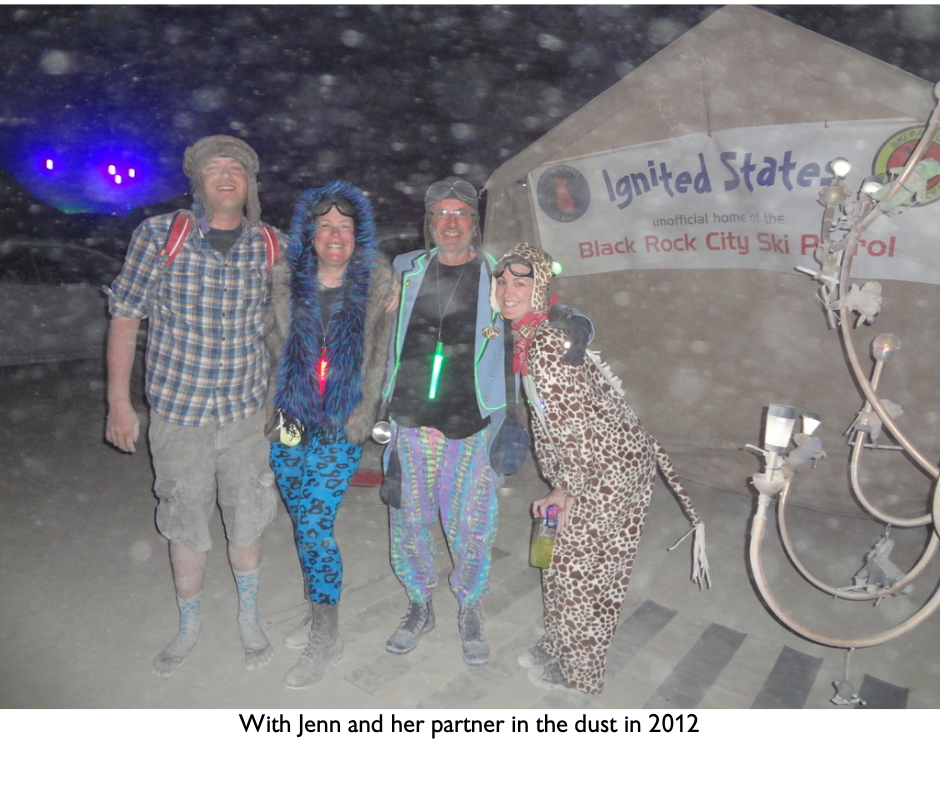
Jenn’s smile lit up every room she entered, and her hug was pure and felt. She loved to dance, especially in the rain. And throughout her illness, she even continued to practice massage therapy – she was a true healer, of both the body and the spirit.
Jenn’s Challenge is simple. Between now and August 10th, do something nice for yourself or someone else, and then tell me about it at this link. Text, photo, and video are all welcome contributions. Between August 10th and when we leave for Burning Man, I turn all of your stories into an art piece that I place in the Burning Man Temple.
I promise you’ll feel good, and your story will become part of a gift to others who will read it at the Burning Man Temple and become touched by it, before it burns with the Temple on September 6th.
Till next time,
Lisa
Whenever you're ready, here are a couple more ways I can help you:
- Assumption Hacking Essentials. If you’d like to strengthen the human side of your TOC practice, sign your team up for Jenrada’s course Assumption Hacking Essentials. It’s specifically designed to highlight how individual and group assumptions drive (or block) sustainable results, offering tools and strategies to ensure your improvements truly stick. You can learn more about the course here. →
- Jenrada Programs. Customized workshops and longer engagements to help you create an organization of aligned problem solvers delivering extraordinary results. Complete this form, send me an email, or schedule a discovery call.



Responses