
6-8 minute read
In our last newsletter, I introduced you to Zombie Measurements. These are metrics or incentives within an organization or industry that should have died long ago, but didn’t. As long as they stay undead, they destroy the kind of results the organization wants. Each Zombie Measurement gets its power from an assumption so familiar nobody thinks to question it. And because of this familiar assumption, no one connects the measurement to the damage the zombie is doing.
The example I gave you last time was sales commissions, one of the most familiar zombie measurements in business. Guided by the belief that it’s the only way to motivate salespeople, this age-old mechanism is also the godfather of pressure tactics, lone rangers, mismanaged leads, and wary customers clutching their wallets as they walk through the shop door. None of these downstream effects are the result of bad actors or inherently greedy people. All of them are because the incentive system rewards certain behaviors.
Today I want to show you one more text-book example of a zombie measurement that feels right and yet is profoundly counter-productive.
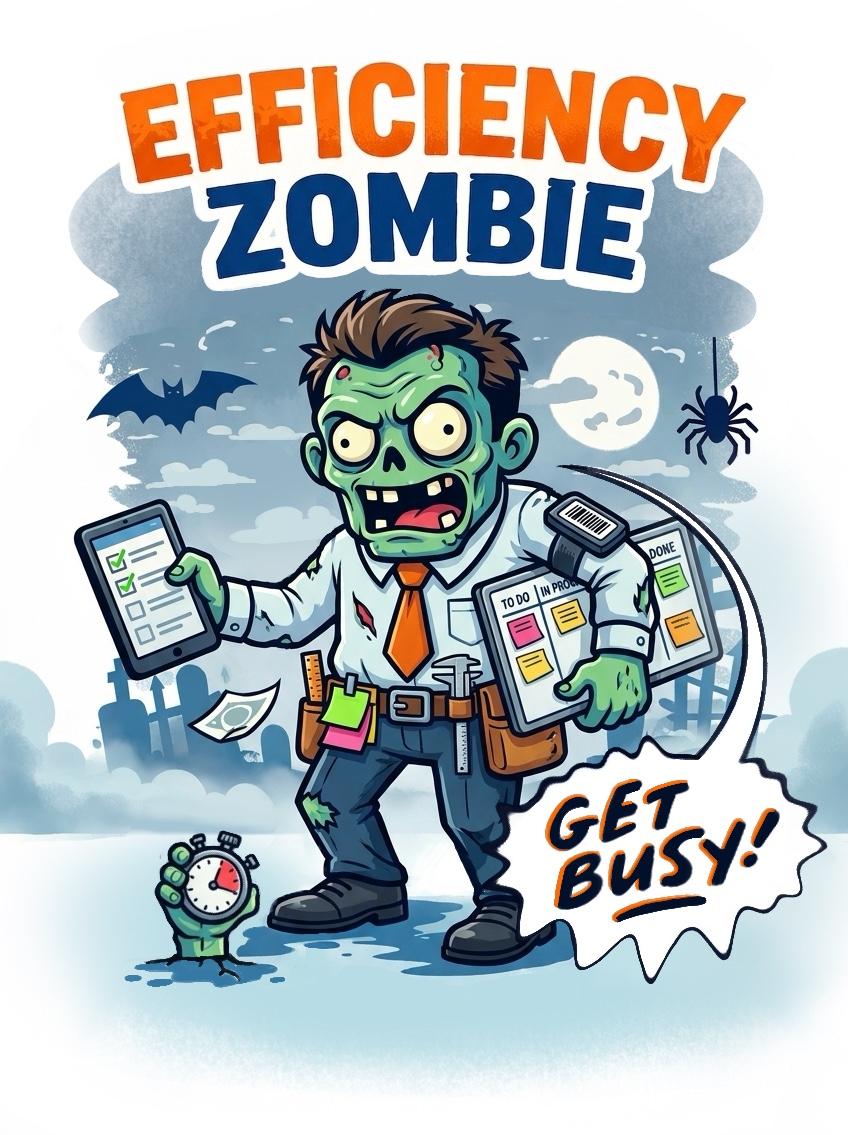
The Efficiency Zombie
Efficiency is doing a task in less time or with fewer resources than some standard or baseline. It answers a simple question: How well did we perform relative to a standard?
Efficiency = Actual Output ÷ Standard Output
Efficiency on its own isn’t a zombie. Wanting people and teams to do good work well, and do it faster, is simply seeking competence.
The Efficiency Zombie thrives on a hidden assumption that renders improved efficiency at the local level to become worse efficiency at the system level. In other words, imagine that one person or team or department getting faster at what they do translates into the organization getting slower and accomplishing less. How could something like this happen?
The Zombie Goes On A Hike
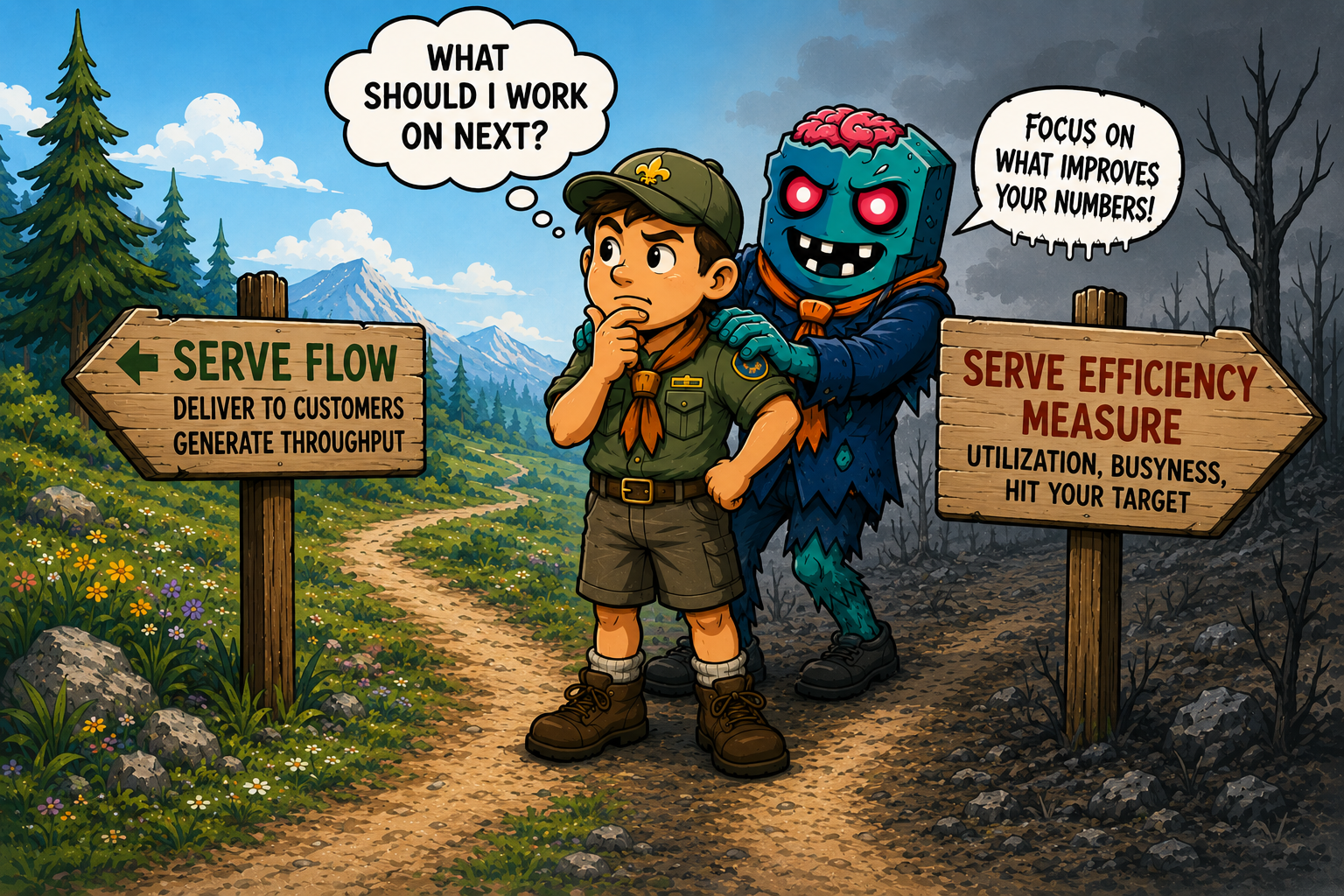
If you’re reading Assumption Hacker’s Advantage, you’ve likely read The Goal, and my bet is you’ll remember the boy scout hike. A troop of boys hiking single file through the woods, each one walking as fast as he can, each one needing to cover the same ground as the boy ahead of him for the troop to reach their campsite.
As the hike progresses, Alex notices that the line keeps stretching out and that the gap between the front and the back keeps growing larger and larger. No matter how hard the rear of the troop tries, it can’t close that gap.
You can think of that space opening up between scouts as work-in-process (WIP). The faster boys at the front aren’t helping the troop arrive sooner, they’re simply creating more space between themselves and the slower boys behind them — more WIP that can never be closed.
It becomes obvious that Herbie is the slowest hiker, and that his pace is slowing down the whole troop from getting to their campsite. Encouraging Herbie to walk faster didn’t help, and neither did cajoling. Alex and the rest of the troop were pretty frustrated with Herbie, but Herbie was doing the best he could.
Notice the zombie on the hike: Every scout is walking as fast as he can, doing his best, and many of the scouts are, in fact, highly efficient at the individual level. Yet the troop performs worse. Nobody’s happy. Well, nobody except the zombie, which is feeding on the troop’s worsening mood.
Alex finally does something that is counter-intuitive: he stops the faster, more “efficient” scouts. He makes them wait. He gets everyone to take a little bit of Herbie’s load, moves Herbie to the front and synchronizes the entire troop to Herbie’s pace. No one walks faster than Herbie. No one gets ahead of Herbie.
Alex’s moves might seem wasteful. At that moment, it certainly seemed so to the faster boys. Fast scouts standing around and waiting is the equivalent of perfectly good capacity sitting idle. And making them walk slower than they are able to reduces their individual efficiencies. But lo and behold, the line stabilizes, the gaps disappear, and the troop happily reaches camp sooner than they would have otherwise, with plenty of time to spare — not because each individual got faster, but because system performance improved. Bye bye, Zombie!

The troop only needed one scout fully utilized and as efficient as possible: Herbie. Everyone else’s job was to support and stay synchronized with him, even when that meant taking on some of Herbie’s load and walking at Herbie’s slower pace. The result was surprising, as they covered more ground faster than when each boy tried to go as fast as he could on his own.
Zombie Food: The Assumption and Its Effects
The brain of the efficiency zombie (and if you know anything about zombies, you know the brain is important!) holds a belief opposite to the one Alex deduced on the hike. It’s a belief so intuitive and seemingly mathematical that, 40-some years after The Goal, it still almost never gets examined. Here it is:
When any part of the system performs better, the system performs better.
Alex learned the fallacy of this assumption on the hike. It showed him that system efficiency depends on how effectively every resource supports the constraint. System productivity improves only when more useful output flows through the constraint — and that requires some resources to do less, not more than they are otherwise capable of doing. And the utilization that matters most? The utilization of the constraint. Maximizing efficiency and utilization of every resource do not contribute to system productivity, they detract from it.
In the story, Alex brought his insight back to his struggling manufacturing plant and turned it around within 3 months. But in the real world, most businesses only have their measurement system, and it says “everybody, be as efficient as possible, and keep moving!”
So they do. Work gets fed into the system faster than it can flow through. And because every resource runs at its own pace — some faster, some slower — WIP piles up. The whole system becomes congested and leaders see bottlenecks popping up everywhere and people are stressed. It looks like the constraint is wandering, but it isn't. The quest for better efficiency everywhere and the congestion it creates is hiding the constraint in plain sight.
Eventually, the pressure becomes visible enough that someone calls for overtime, extra shifts, or some kind of heroic effort. The backlog clears and everyone exhales. And then the same pressure that created the problem starts up again. More work gets pushed in. Utilization climbs. WIP builds. Flow slows. Crisis, overtime, relief. Rinse and repeat.
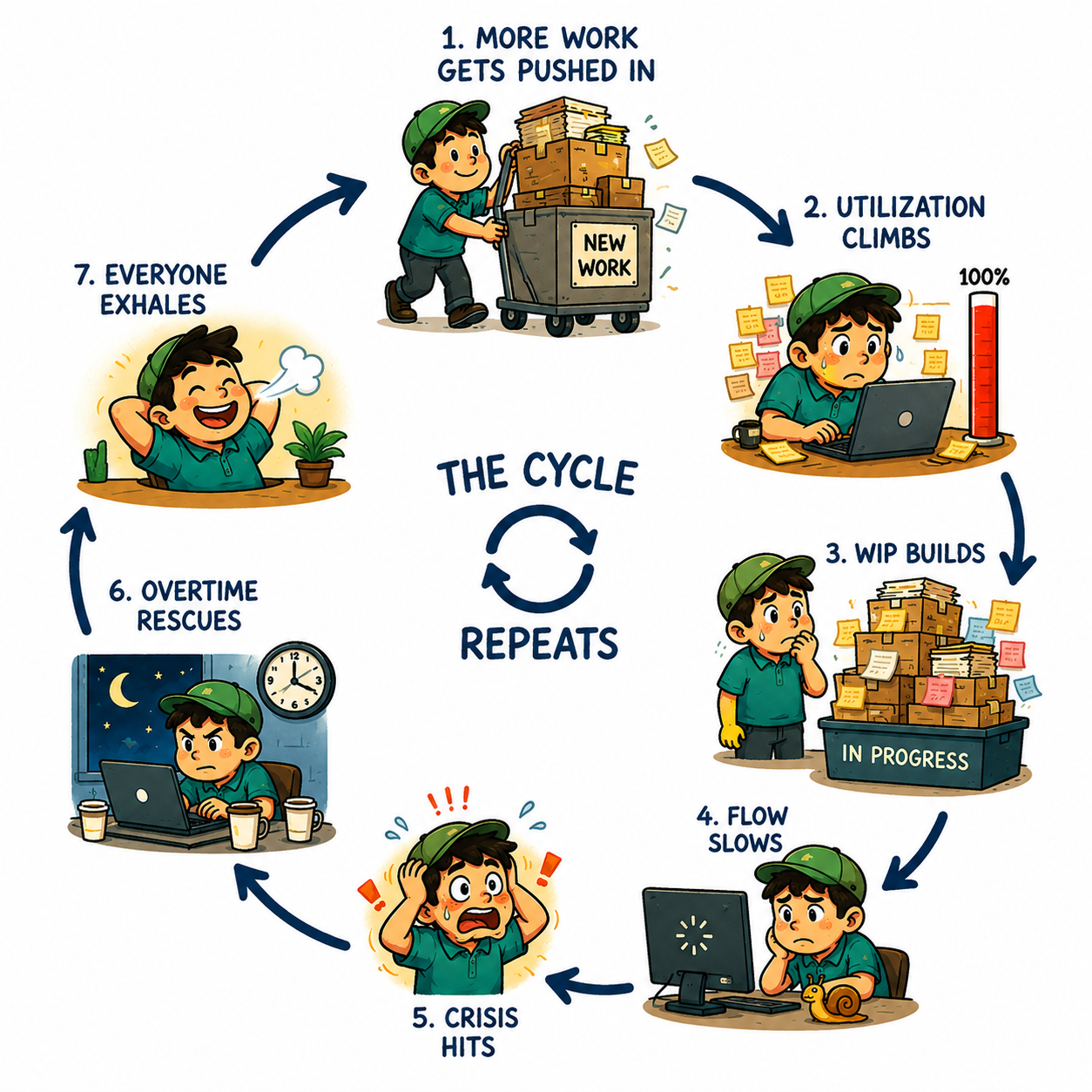
Because every time something rescues the system, it looks like the pressure worked. Nobody connects the cycle to the measurement system that created it, and the zombie stays undead. Zombies thrive on vicious cycles.
Efficiency Zombies at Non-Constraints
I don’t want to imply that increasing the efficiency of non-constraints is always harmful. When a non-constraint speeds up in service of the constraint — getting good work to it faster, converting its completed output into throughput more quickly — that genuinely improves system performance. That is, as long as it doesn’t also decrease constraint efficiency or utilization. Cycle times compress, lead times shrink, and less inventory waits in queue.
The difference isn't whether non-constraints are efficient. It's why they're efficient and what signal they're responding to. Efficiency in service of the constraint improves the system. Efficiency in service of a local scorecard risks harming it.
This is because not all resources are equal. Every system has a constraint — the most limited resource, the one that ultimately determines how much the entire system can produce. At the constraint, maximum efficiency combined with maximum utilization is exactly what you want. A constraint sitting idle is genuinely expensive. So is a constraint producing poor quality or unneeded output.
Everywhere else, the job is different. The job of every non-constraint resource is to serve the flow by supporting the constraint, not the traditional local scorecard. That's a fundamentally different objective than maximizing local efficiency and utilization independently.
When we lose that distinction — when we measure and reward every person as though their performance independently improves the system — we don't get stronger organizations, we get fragile ones that are locked in the vicious cycle the zombie feeds on.
This Zombie Gets Personal...
When efficiency pressures get baked into compensation systems (e.g. through piecework, flat rate pay, or output-based incentives), staying busy stops being a management expectation and becomes the sincere objective of individual rational actors. The zombie expands its territory, feeding on exactly the same conflicts we exposed in the previous newsletter.
...And Gets Around
There's a reason this zombie, like most good zombies, is so hard to kill. Efficiency gains don't convert to money on their own. A nurse who completes their charting faster than before doesn't reduce costs if the same number of nurses are still on the clock. So organizations capture efficiency gains the only way they know how: by running leaner. Fewer people. No backfill when someone leaves. Existing people absorbing more. And once that decision is made, high utilization becomes almost the holy grail — “look, everyone is busy, nobody is idle, we have lowered our costs, we are lean and efficient”. The savings are on the books and the zombie is now load-bearing.
You’ll find this zombie in manufacturing, where machines are kept running whether downstream processes need the output or not. In engineering, where over-loaded teams become one of the reasons projects run late. In hospitals, where staffing pushed to maximum utilization creates less availability of needed beds. And in many types of automotive service departments, where every technician stays fed with work whether or not the flow actually needs it.
Different industries, different uniforms, same zombie.
Examine the core belief – that any part performing better is the same thing as the system performing better– with genuine openness. Then find the organizations, the teams, the shops that deliberately protect slack in their non-constraint resources — the ones with the courage to tell their fast scouts to wait, and even to take some of the load from their version of Herbie. Look at their flow, their reliability, and their culture.
One More Thing Before We Go
Notice anything familiar?
The same thinking that makes sales commissions feel logical — reward output, eliminate slack, measure every individual’s contribution — is the same thinking that drives efficiency and utilization pressure in operations.
That isn't a coincidence. There’s something underneath both of these zombies, a management logic so widely adopted it has become almost invisible. And it’s the thing that makes Zombie Measurements so terribly hard to kill.
We’ll name it in the next issue.
Till next time,
Lisa
Whenever you're ready, here are a couple more ways I can help you:
- Assumption Hacking Essentials. If you’d like to strengthen the human side of your TOC practice, sign your team up for Jenrada’s course Assumption Hacking Essentials. It’s specifically designed to highlight how individual and group assumptions drive (or block) sustainable results, offering tools and strategies to ensure your improvements truly stick. You can learn more about the course here. →
- Jenrada Programs. Customized workshops and longer engagements to help you create an organization of aligned problem solvers delivering extraordinary results. Complete this form, send me an email, or schedule a discovery call.

Responses