
8-10 minute read
A few weeks ago I sat down with a CEO of a public company who spent much of his career at the top of the accounting world. He was a Partner with a major firm, led audits, and was the kind of person a company calls when things are bad enough that someone senior has to walk in and figure out what's actually going on inside the numbers.
As we spoke our conversation converged on the somewhat inevitable subject of cost accounting. And let me tell you, he didn’t mince words. He didn’t say "be cautious," or "use it carefully", he simply said he wants nothing to do with it. He told me that once he saw businesses through the lens of Theory of Constraints, a discipline he credits with saving more than one company he worked on, he refused to go back. And now that he runs his own company, he's told his staff more than once:
| If I spend more than 3% of my time on expense management, shoot me. |
I found his insights on the subject interesting not because he’s a TOC aficionado (our kind complain about cost-accounting practically as a pastime) but instead because this was his world. This is someone who spent years being the most credentialed person in the room on exactly the system he now refuses to run his company by.
Furthermore, his line isn't only about cost accounting as a methodology: it's about time — specifically, how much of an organization's time gets spent focusing on costs at the expense of focusing on what would actually grow the business profitably.
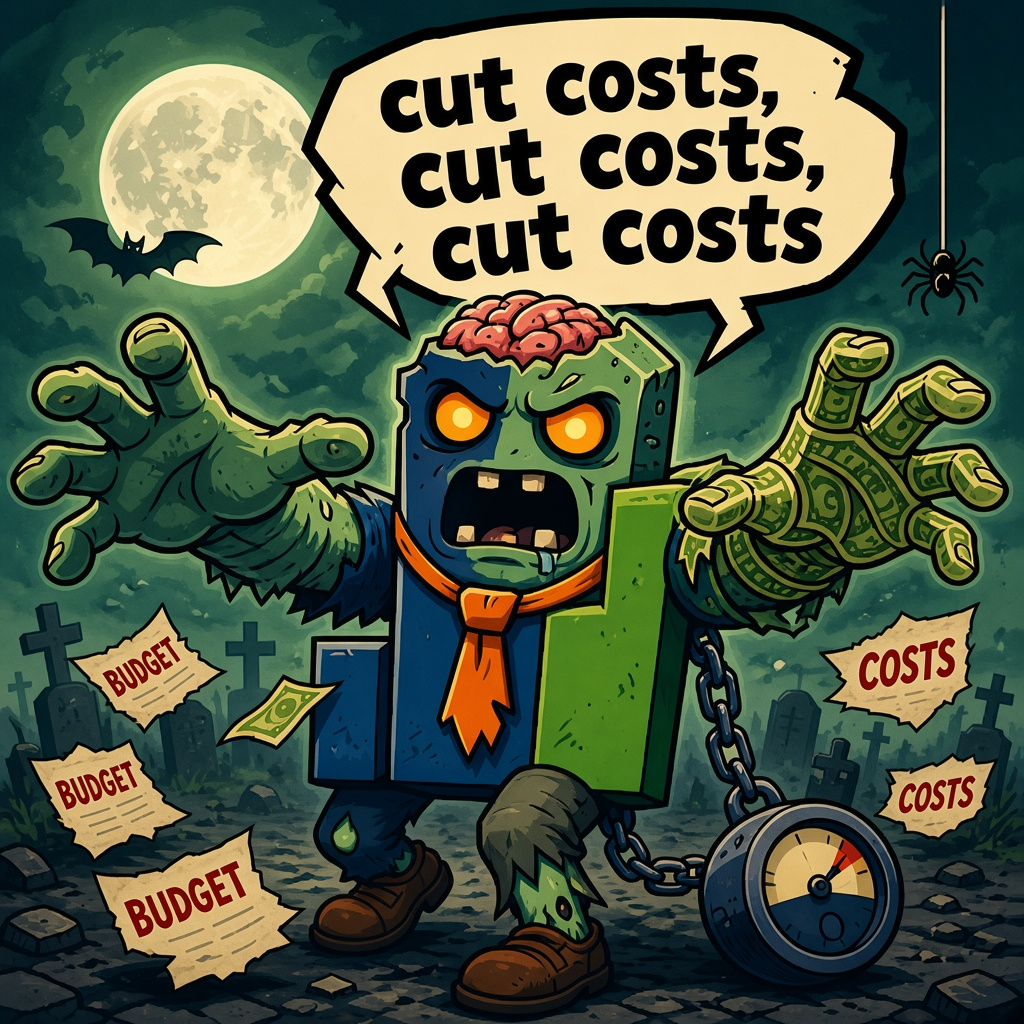
I chuckled as I listened to him, recalling so many executives, managers, and teams I've watched spend exorbitant numbers of hours and days leading up to budget reviews (which are 99% centered on expenses), working feverishly to defend their variances. They build the deck, rehearse the answer, and do their best to get ahead of the question before someone senior asks it. That pattern isn't rare and it isn't new. I watch it happen in real organizations, on a schedule, like clockwork.
Before I go further, I want to be clear about what I'm actually arguing, because it would be easy to hear "budgets are zombies" and assume I mean planning itself is the problem. It isn't.
Building a plan — what we intend to sell, what we estimate it will cost, how much we anticipate we'll have leftover as profit and cash — is a completely reasonable thing to do. You should have a sense of where you're headed. The zombie isn't the plan.
So what is the zombie?
A few months back I introduced the idea of zombie measurements in this newsletter. We define it as a metric that should be dead but instead it wanders around, destroying the results the organization actually wants. The zombie I'm introducing to you today is an extraordinary, nth decimal-point focus on costs. You might also recognize this as “cost world thinking”, a phrase Eli Goldratt coined in 1990 in his book, The Haystack Syndrome.
Whatever you name it, this zombie is protected by a single assumption that almost nobody questions: costs are the one thing we can actually control, so cost containment must be the surest path to increasing profits.
I want to be fair to this belief, because it isn't stupid on its face. Most companies compete in markets where their customers genuinely can't tell them apart from the competition. Not because customers are unsophisticated, but because the products and services these companies offer are close enough, from the customers' view, to be interchangeable. And while many business owners and managers believe they’re different in xyz way, their experience tells them that the the money they spend is within their control, the money they take in is not. Revenue depends on customers, but customers do what they want, for their own reasons.
The zombie gets fed, everywhere, all the time.
The spiraling damage
Once cost is believed to be the one sure lever, people tend to use it everywhere. Every penny in every department starts to matter equally. Budgets — more specifically, budgeted spend — becomes the law of the land, and department heads spend enormous energy fighting for their piece of the budget. They’re not doing it out of pettiness, they’re doing it because they genuinely want to adequately fund the work their teams need to do. It’s a sympathetic motive feeding a destructive system. What looks from the outside like simple office politics — departments competing hard against each other for a shrinking, fixed pool of money — isn't a culture problem you can solve with a values statement or teambuilding exercises. It's what this belief produces, every budget cycle.
The implications of this can turn into acrimony. When every penny is treated as equally important, any penny that goes missing has to be accounted for. A variance stops being information and becomes an accusation. The instinct isn't "what did we get wrong about our assumptions, and what does that teach us?" It's the accusatory "who owns this?" That reflex is simply what the zombie produces the moment reality doesn't match the plan, which it reliably won’t. A plan is an estimate, not a prophecy.
And finally, here's what makes this a spiral instead of one-off: all the time spent fighting for budget and defending variances is time that isn't spent figuring out how to actually be different from the competition. So the company remains indistinguishable from their customers’ perspective, those customers still go elsewhere for no reasons apparent to the company, and that makes them feel like they need to focus more on cost because that’s their only perceived point of control. The outcome doesn't make anyone question their original experience or intuition — it confirms it. "See, cost really is our only lever." No one notices the role they play in this vicious cycle. The assumption gets fed by the very damage it caused, and the zombie comes back stronger next cycle.
Slaying the Zombie
The belief driving all of this — cost control is the only real lever we have over profits — is wrong. But the reason it's wrong is more important than the fact that it's wrong, because the reason is what will actually allow us (and you) to kill this zombie.
Cost-cutting is, by its nature, a bounded game. It has a hard limit. Let’s take it to the extreme. What if you were to cut all of your costs to zero? Long before you get anywhere near zero, you run into diminishing returns — the third round of cuts finds far less than the first, and eventually you're cutting into the thing that lets you serve customers in the first place.
Throughput (the rate at which the system generates money through sales) isn't bound the same way. In Eli Goldratt's own words: "Even the sky is not the limit" when the vast majority of an organization's attention goes toward increasing throughput, as long as over time, throughput grows faster than operating expense and inventory.
There's no equivalent ceiling on how much value you can create for customers, how many of them you can serve, or how much they might be willing to pay for something they genuinely want. The lever everyone treats as the only one they have is the bounded one. The lever with no real ceiling is the one that gets almost none of the attention.
The solution to the dynamic isn't to try and force differentiated value for your customers through sheer will. That’s not a strategy. Instead, it's recognizing that the energy you currently spend on managing, explaining, and defending expense lines could go toward answering the one question that actually would give you leverage over profitability: What would make customers value what you offer more than they currently do — and more than they currently believe your competitors do?
That's not a platitude about customer obsession, it's a literal reallocation of where the smartest people in your company spend their time and attention each month.
Three weapons for slaying the Budget Zombie
Unlike improving throughput, cutting costs doesn't need a methodology. You just cut. But if you do want to grow throughput, you have to do so on purpose. Luckily TOC gives you tools. Here are three:
Use throughput world thinking to sever the every-penny-matters-equally belief that pits departments against each other in the first place. Cost world thinking has no order of priority — every expense, everywhere, matters the same, which is exactly what makes every dollar eligible to be cut or fought over. Throughput World thinking has an explicit order instead:
- Throughput first: the rate at which the business generates money through sales;
- Inventory second: the money invested in things the business intends to convert into throughput;
- Operating Expense a distant third: the money the business spends to convert inventory into throughput;
To further quote the CEO I introduced you to at the start of this newsletter:
| The more we are not focused on throughput, the more money we truly throw away. |
In practice, that means when a department head is deciding where to spend the next hour, growing throughput outranks trimming a lower expense line — not just when times are good, but as a standing priority. Once expense dollars stop being the main thing on the table, they stop being the thing departments compete over. Much more on this subject is coming in the next newsletter, but I'll add just a bit here. When the subject of adding a new expense or investment is on the table, assessing the degree to which that expense or investment is expected to increase is not unimportant!
Use mystery analysis to eliminate the variance-defense reflex. When a result comes in different from what you expected, don't start with “who's at fault”. Start with the expectation itself. What did you expect to happen, based on what you planned to do? What actually happened? What assumption produced that expectation — the one you likely weren’t consciously aware you were making until the gap showed up? What, specifically, was wrong with it? Should any course corrections be made based on what you’ve learned? That's the whole process in a nutshell. It turns a variance from something you defend into something you investigate and learn from.
| If you want to know more about mystery analysis, respond to this newsletter and I’ll send you a free resource. |
Use buffer-based budgeting to dismember the structure that has every department padding, hoarding and defending its own request. If you know critical chain project management, you know the trick: instead of padding every single task estimate with its own safety margin — margin that gets quietly absorbed and wasted no matter how generous it is — you strip the padding out of individual tasks and pool it into one project buffer. Tasks that run long draw from the buffer. Tasks that finish faster give some of it back. The project's real deadline gets protected without every task manager hoarding padding that nobody can see.
The same logic can be applied to budgets. Instead of every department buffering its own request and then either sitting on it defensively or spending it down to zero so next year's number doesn't shrink, you pool the safety margin and let it move to wherever it's actually needed, when it's actually needed. This is not a new idea. It's been done. But it hasn’t been largely adopted, and here’s why: it requires trusting that people will spend only what they need and hand back the rest, and most organizations quietly assume the opposite — that if you hand someone a budget, they will find a way to spend all of it, need or not. That distrust, not any flaw in the technique, is what keeps organizations padding every line instead of sharing one pool. But it’s also what keeps managers spending their time focused on every line instead of how to be different from the competition.
Zombie Defense Starter-Pack
You may or may not be ready to implement any of the three operational practices. The starter pack might feel less risky, and give you some ammunition.
- 👀 Look at where your best people's attention actually was last quarter. If the honest answer is "rationalizing expense lines", you've found your zombie, regardless of what your budget process is officially called.
- 🧭 Ask yourself, honestly, what order your organization actually optimizes on day-to-day. If lower expense lines routinely win attention over throughput opportunities, you're running on cost world thinking no matter what your strategy deck says.
- 💬 Ask, out loud, in a budget meeting, what it would take to pool even a portion of your departments' safety margins into one shared buffer instead of padding every line separately. Watch who gets nervous, and ask them why.
- ✋ The next time someone tells you a number came in under or over plan, resist the urge to ask who's responsible before you've asked what was being assumed when the plan was built in the first place.
One More Thing Before We Go
If you’ve been following along with this Zombie series, you know I’ve discussed sales commissions and efficiency metrics already. Each of these, including today’s subject, look reasonable on the surface, yet once we dive in, we see the Zombies and the damage they do.
For my fourth and likely final instalment in the Zombie Measurement series, I'll share with you the whopper of a zombie that super charges each of the Zombies I’ve described so far.
And it will reveal the other important reason why the CEO I mentioned in the opening of this newsletter has sworn off of cost accounting.
Till next time,
Lisa
Whenever you're ready, here are a couple more ways I can help you:
- Assumption Hacking Essentials. If you’d like to strengthen the human side of your TOC practice, sign your team up for Jenrada’s course Assumption Hacking Essentials. It’s specifically designed to highlight how individual and group assumptions drive (or block) sustainable results, offering tools and strategies to ensure your improvements truly stick. You can learn more about the course here. →
- Jenrada Programs. Customized workshops and longer engagements to help you create an organization of aligned problem solvers delivering extraordinary results. Complete this form, send me an email, or schedule a discovery call.

Responses